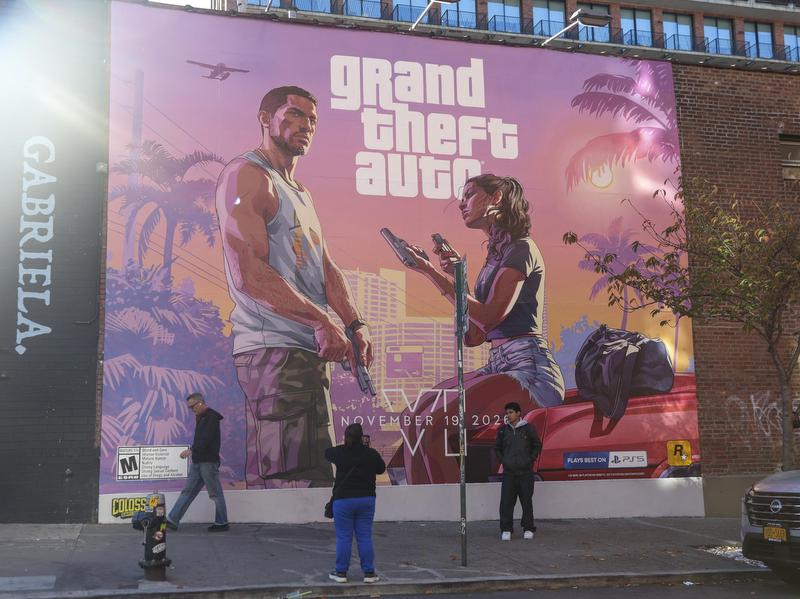
A viewer of Grand Theft Auto VI live streams can visit Vice City through someone else’s screen, without taking on the demands of gameplay. The writer says this is a pragmatic way of fitting play into everyday life, carving out leisure amid work, childcare and household responsibilities.PHOTO: EPA
Grand Theft Auto VI: Why gamers are watching live streams instead of playing it
It’s finally here. That would be the ecstatic cry across countries for the fans who waited 13 years. Grand Theft Auto VI (GTA VI) has arrived, billed by industry analysts as the largest entertainment launch in history.
People around the world have gone to surprising lengths to play the latest edition of the game with new PlayStation consoles and taking leave from work. One Singaporean couple went viral for their tongue-in-cheek “contract” granting the husband 10 days of uninterrupted play.
For many millennial players like me, however, GTA is more than just playing it solo. Playing GTA in the late 1990s and early 2000s became a mythical teenage bonding ritual – a wrinkle in time when we would gather at a friend’s house with a single console, taking turns at the controls.
One person drove, another offered live commentary and the rest shouted like backseat drivers, issuing diabolical instructions that the player would wilfully ignore. We were all playing together, even when only one person held the controller.
In 2026, many of us will return to GTA’s world without ever picking up a gamepad. Watching someone else play on a live stream is a legitimate mode of play in its own right.
The GTA hype
Part of GTA’s enduring allure has been its architectural ambition. Its fictional cities reimagine real-world urban landscapes, cities you might have seen in pictures even if you had never visited them before: Liberty City is evocative of New York, Vice City represents Miami, and San Andreas compresses a California-like landscape tinged with a 1990s Boyz N The Hood influence.
Spend enough hours roaming those streets in someone else’s living room and you get the uncanny sensation of knowing a place that you have never visited.
To be sure, the franchise sparked endless moral panics on the transgressive thrills of doing things most of us would never do in real life. As its title suggests, you can steal cars and then drive around dodging the police, while engaging in all manner of unsavoury criminal acts.
In later instalments, GTA became even more elaborate in its imitation of real-life structures and missions. Many players abandoned the script altogether, treating the city as an open-ended playground for aimless exploration.
GTA IV (2008), which I also spent many hours playing on PC, introduced a friendship system with non-playable characters and a maddeningly convoluted in-game mobile phone. But who had time to maintain a virtual social calendar when there was an entire city to explore?
GTA VI takes this to another level, with extensive field research going into its production. One Bloomberg article reported that the GTA VI world was the result of “excursions” by its makers around Miami, on which the game’s fictional Vice City is based. Producers of the game travelled through the city with police, visited local entertainment joints and rode in helicopters to capture details.
That instinct to treat a virtual city as a place to inhabit, rather than a checklist of missions to complete, turns out to be ideally suited to the streaming era.
These cities are not just convenient backdrops for action, but also a living world in which an aimless night-time drive with the radio on can become its own story.
Watching someone else play allows us to discover the city through their choices, and feel part of something larger than our individual actions within it.
There is a certain voyeuristic pleasure in watching another player’s accidents, detours and unpredictable meanderings, and seeing a world unfold without having to take the wheel ourselves.
A world of watching
Many are likely to experience GTA VI by watching someone else play. Through gameplay videos and live streams, viewers can watch, react and talk about GTA, joining in on this massive social event from a distance.
In 2024, GTA V was the most-watched game on the popular video game platform Twitch, where people watch others play – with a staggering 1.4 billion hours of watching.
The live-stream viewer can see Vice City through someone else’s gameplay, following the action without taking on all the demands of playing or arranging to meet friends. If you feel you need a break, just pause the video. If you feel social, you can join the live chat.
I see it as a redemptive tactic of resistance. Rather than passive consumption, this is a pragmatic way of fitting play into the cracks of everyday life, carving out leisure amid work, childcare and household responsibilities.
Even spectatorship can feel like a small act of reclaiming time for play. It is not the same as playing together in the same room with your friends, but neither is it being simply alone with the game. It is a new form of keeping company with others at a distance of your choosing.
The communities in-game and around the game can be lively, though they aren’t automatically safe or welcoming, especially around a mature and intentionally transgressive game which sits alongside an online gaming culture where gendered harassment, hostile chats and attention-seeking antics could easily become part of the spectacle.
Such behaviour can also attract views in the attention economy, giving some streamers incentive to become more provocative.
Yet, watching also offers us the freedom to choose what version of the game we want to experience, and which communities we choose to spend our time in. We can look for moderated spaces, follow the players whose voices and perspectives interest us, or simply leave when the experience stops being enjoyable.
Ultimately, GTA VI presents a kind of freedom.
Much of the real world is beyond our control, so such games appeal to us not only because we can engage with the virtual world in different ways, but also because they give us a glimmer of control in an uncertain world.
Grand Theft Auto has gained in popularity over three decades not just because of its criminal plots, but also because there is a seduction of a dense, unscripted world where half the pleasure lies simply in watching life unfold on the street and in the communities online.
SEE LIFE • C9
Debbie Ding is assistant professor of practice in Digital Arts at the Singapore University of Technology and Design, and an artist who makes playable games and artwork about walking through real and virtual cities.
Online communities are perfectly content exploring Vice City and just being in the neighbourhood.