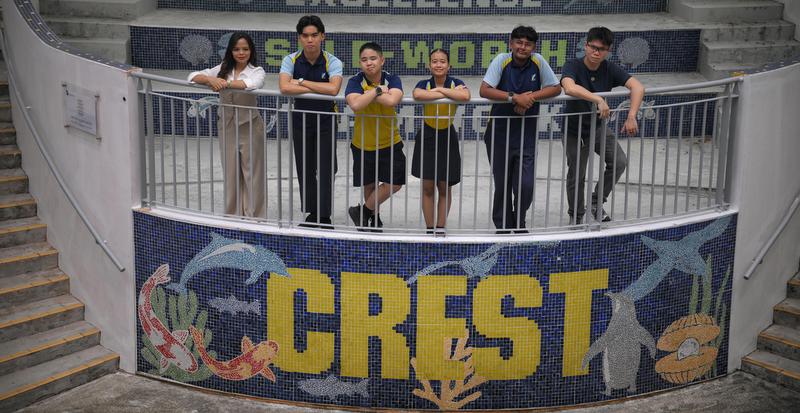
1 of 2 Crest Secondary School alumni Nur Saminah Sabtu (far left) and Eric Liang (far right) with current students (from left) Asher Cheow, Willy Ng, Ellefirah Ellyza Muhammad Firdaus and Muhammed Gaazi Basheer Ahmad.ST PHOTO: MARK CHEONG
School Spotlight
A different route to success
Crest, Spectra Secondary schools’ non-judgmental environment helps students find their footing
Receiving the PSLE results can feel like a make-or-break moment for a 12-year-old. When Eric Liang picked up his results slip back in 2013, the number staring back at him was 112, which posted him to the Normal (Technical) stream.
REBUILDING CONFIDENCEHands-on, skills-based learning gives students the opportunity to experience success in new ways, which is often the first step in rebuilding confidence and motivation.
Spectra Secondary School principal Tan Teck Hock
Today, 25-year-old Liang is a third-year undergraduate pursuing a Bachelor of Arts in Architecture at the National University of Singapore (NUS).
His path from a score of 112 to one of the world’s top universities began after a visit to Crest Secondary School in Jurong East. Led by his primary school teachers, the trip, which was for for foundation-level pupils, convinced Liang that it was the right place for him.
Crest is one of two specialised schools in Singapore for N(T) students. It opened its doors in 2013, followed by Spectra Secondary in Woodlands, which admitted its first Secondary 1 cohort a year later.
In his National Day Rally speech in 2010, then Prime Minister Lee Hsien Loong announced their establishment as an additional option for pupils eligible for the N(T) course.
The stream structure has since evolved. Under full subject-based banding implemented by the Ministry of Education in 2024, the former N(T) stream roughly corresponds to the G1 standard, while Normal (Academic) maps to G2, and Express to G3.
Now, Crest and Spectra accept applications from Primary 6 pupils who achieve a PSLE score of between Achievement Level (AL) 26 and 30, the range aligning with Posting Group 1. They must also score AL 7 or better in English language and mathematics.
Students who score AL 25, who fall into the option band between Posting Groups 1 and 2, can apply as well.
Yet, despite this progressive pedagogy, Liang recalls facing stigma surrounding these specialised pathways as many families were then unfamiliar with them. “Some people say that going to Crest is like ‘the end’,” he recalls. “But I disagree completely. Going to Crest isn’t the end. It’s a redemption.”
He adds: “The school is trying to change your path to a brighter future while letting you know that you are never alone in this journey.”
A different way of learning
Stepping away from textbook-heavy learning and written exams, Crest and Spectra adopt a hands-on, skills-focused approach designed to help students discover where they shine.
The goal is to reignite a passion for learning, rebuild confidence, and pave a clear path to post-secondary education and future careers.
More than 90 per cent of students progress to the Institute of Technical Education (ITE). From there, a steady stream go on to pursue diploma programmes at polytechnics – and some, like Liang, advance to universities.
Alongside three academic subjects, English, mathematics and mother tongue, students spend Secondary 3 and 4 diving into two out of five vocational tracks: mechanical design and automation, culinary and restaurant operations, retail and e-commerce, internet of things applications, and mobile web applications.
These subjects are industry-aligned modules developed in close partnership with ITE. The students leave secondary school with two nationally recognised qualifications: a Singapore-Cambridge Secondary Education Certificate and an ITE Skills Subject Certificate.
Levelling the playing field
In a typical mainstream secondary school, G1 students make up about 30 per cent of the cohort. Being a minority means they may feel overshadowed, be overlooked for student council posts or hesitate to step up.
Crest Secondary School principal Benjamin Kwok says: “Many students feel a bit defeated after the PSLE when posted to G1. But when they come to a school like Crest, there’s no G1, G2 or G3. Everybody is the same and there are no more labels.”
Crest vice-principal Lee Kee Meng highlights how removing that dynamic transforms a teenager’s self-esteem: “If you go to a mainstream school, you are competing with G2 and G3 students for leadership positions. But here, everyone gets a chance to step up. Just because students have not done well academically doesn’t mean they are devoid of potential.”
Crest vice-principal Celine Wong adds: “Everyone starts from ground zero on equal footing. When we create a caring environment with fair opportunities for all, that is where students build their confidence and thrive.”
A culture of safety, care and connection
At the heart of both Crest and Spectra is a deeply caring team dedicated to nurturing their students.
To better connect with the teenagers, Kwok says some of his Crest staff also bring unique backgrounds and talents.
For instance, youth engagement officer Mohamad Nor Rizan Abdullah, a former professional boxer, works closely with students on character building.
Meanwhile, senior teacher Ian Poh, a street dancer with stage experience from Paris to Singapore, oversees the performing arts, where students learn music, drumming, singing, dancing and rapping.
That care extends into everyday interactions, making the school feel like a welcoming second home. Students often take the initiative to join their principal and vice-principals for meals in the canteen, sharing candid conversations.
Creating a safe space also means supporting students when they struggle emotionally.
Kwok remembers an incident from his early days at the school that left a lasting impression on him. After the morning flag-raising, as students filed off to class, one boy stayed behind in the hall, lying on the floor.
Instead of reprimanding him, vice-principal Othman Arsan Mohd Abubakar, who was a head of department at the time, simply walked over, sat down on the floor next to the boy and had a chat with him until the teenager felt ready to return to class.
Reflecting on that moment, Othman explains his approach: “We want to create an environment that is as non-judgmental and educational as possible. We acknowledge that our students’ brains are still developing and some of the wiring needs to be rewired through positive new experiences.”
For 26-year-old pioneer alumna Nur Saminah Sabtu, that supportive culture made all the difference. She is currently pursuing a part-time degree in global business management at Britain’s Northumbria University through Kaplan Singapore, a private education institution.
“(The school culture) helped shape my confidence, character and perspective towards learning and working life,” says Saminah, who is now an associate buyer in the information technology services and solutions industry.
“The teachers were so encouraging and made me want to keep growing and pursuing my studies. Whenever students faced problems at home or in friendships, the teachers were always there to talk to us and make us feel better. They felt like family.”
Building world readiness and industry experience
Alongside character building, Crest and Spectra integrate global exposure and industry attachments into students’ four-year learning journey.
In Secondary 2, all students go on an overseas learning trip to broaden their horizons. The following year, they undertake an industry work attachment programme that gives them a taste of working life and helps them make informed choices about their post-secondary pathways.
Beyond their creative curriculums, both specialised schools also feature unique learning environments designed to mirror real industry settings.
At Crest, students learn inside a simulated Uniqlo retail outlet and a mock Giant supermarket designed for teaching retail management and store operations.
Over at Spectra, some classes take place within a purpose-built FairPrice supermarket space.
Each school admits around 200 students every year. Spectra principal Tan Teck Hock says class size is kept to about 20 students, with most classes supported by two form teachers. Dedicated counselling and specialised learning support are also available.
This small-group approach was reassuring for 17-year-old Dinie Nur Firska Nurul Firdaus, recipient of the Lee Kuan Yew Award for All-Round Excellence (Secondary) in 2026. She is currently studying passenger service at ITE College Central.
“With smaller class sizes, teachers really try to know us well,” she says. “They are able to give us individual attention and understand our strengths and where we need support. That creates a safe environment where you feel supported.”
She is also grateful for various leadership opportunities, such as serving as a student councillor and leading her co-curricular activity, the school’s music club, as president.
“When I first came to Spectra, I never saw myself as a leader. My teachers saw potential in me before I saw it in myself. Their trust gave me the courage to try.”
Both schools also put considerable effort into making campus a place teenagers enjoy going to, with spaces where students can unwind over computer and board games after school.
This extends into a wide range of hands-on enrichment. At Spectra, for example, activities span make-up and hairstyling, joining a pop band and learning how to repair bicycles, reflecting the belief that every child has unique talents waiting to be discovered.
For alumna Emelyn Quek, now a radiology nurse after earning her diploma in nursing at Nanyang Polytechnic in 2025, that varied exposure helped her find her path.
“Before coming to Spectra, I wasn’t really sure what I was good at,” the 25-year-old says. “It gave me the space, exposure and practical opportunities beyond textbooks to discover different sides of myself and realise what I was truly capable of.”
Principal Tan believes this is where confidence takes root. “For students who may have had a difficult time in primary school, the smaller class sizes and dedicated support mean that teachers can build genuine relationships with each student,” he says.
“The hands-on, skills-based learning gives students the opportunity to experience success in new ways, which is often the first step in rebuilding confidence and motivation.”
Finding the right school after PSLE
Choosing a secondary school is not about following conventional expectations, but about finding an environment where children can thrive at their own pace.
Looking back on her growth, Quek offers this advice for Primary 6 pupils: “Don’t underestimate yourself or think there is only one way to succeed. Everyone learns differently.”
That sentiment is echoed by Dinie: “A student’s potential is not defined by who they are when they first enter the school, but by who they can become when they are given the right opportunities, guidance and encouragement. Spectra gave me that chance and I believe it can do the same for many other students.”
From his perspective as an NUS architecture student who started with a PSLE score of 112, Liang says: “People say every school is a good school, but when you choose a school, the real question is: Does this school fit you? Does it bring you to where you want to be when you grow up?
“It’s not just about academics, but about the four years you spend there, making friends and having teachers who can change your life.
“My primary school teacher once told my parents that Crest fitted me because it would teach me patiently. It gave me the supportive system I needed to learn slowly and regain my confidence.”
CONTINUED on C2
Small classes, fun after-school activities, as well as a safe space
FROM C1