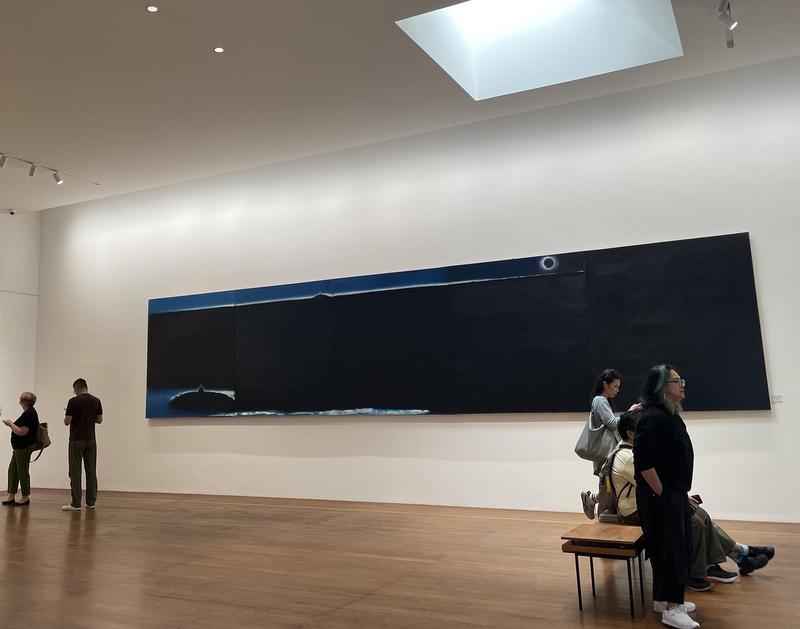
1 of 4 A large triptych, largely black with strokes of twilight blue suggesting a horizon, hangs in Museum Srihadi Soedarsono.
Explore art in Bandung
Beyond street food and shopping, creativity lies in the core of the city
BANDUNG, Indonesia – Bandung, the capital of West Java, is legendary among Indonesians for its street food culture and factory outlet shopping.
Having spent the first 18 years of my life in Bandung, I am usually driven by nostalgia during my return visits – meeting old friends and visiting the food haunts of my childhood.
So when a group of friends suggested an art exploration trip, I jumped at the chance to see my home town through a fresh lens.
Art hubs in South-east Asia usually bring to mind Yogyakarta and Bangkok. Yet, creativity is part of Bandung’s core identity – it has been a member of the UNESCO Creative Cities Network since 2015.
Bandung plays a key role in shaping Indonesian modern art.
In the absence of a national arts council, each region operates autonomously, resulting in distinct art movements. Between the 1930s and 1950s, Yogyakarta-based artists often used art as a tool of social awareness and political awakening. Artists such as S. Sudjojono and Hendra Gunawan often portrayed domestic life struggles or battlefront scenes.
During the same period, art took a more academic approach in Bandung with the establishment of the Indonesian Fine Arts Academy under the Bandung Institute of Technology (ITB). Renowned artists such as Srihadi Soedarsono and Sunaryo Sutono embraced Western styles like abstraction and Cubism, combining them with Javanese spiritual philosophies to create paintings and sculptures.
On a four-day trip in March, I set out to discover what makes the Bandung art ecosystem thrive.
A maestro’s legacy
The grey, minimalist monolith rises starkly in the hilly Ciumbuleuit neighbourhood of Bandung. There is no entrance to be seen, so we climb the only visible path, a narrow outdoor corridor leading to the museum.
Museum Srihadi Soedarsono (tickets cost 30,000 rupiah on weekdays and 40,000 rupiah on weekends), named after one of Indonesia’s most prominent modern painters, is one of Bandung’s newest cultural landmarks.
Designed by renowned Indonesian architect Andra Matin – who is also behind Bali’s Potato Head Beach Club – the museum opened in September 2025.
Srihadi spent four decades as a lecturer at ITB and conceived the museum as a residency to mentor young artists, says Puti Astrid, our guide.
“But he died in 2022 as construction was about to commence, so it pivoted to become a museum,” she adds.
In the main gallery, a large triptych commands the room. Black paint dominates the canvas, with strokes of twilight blue suggesting a horizon.
Looking closer, I notice the silhouette of Borobudur Temple, which was one of Srihadi’s signature subjects. Standing before it feels like gazing at the magnificent temple from a distant hill as dusk settles.
Zen in Wot Batu
Open-air museum Wot Batu (tickets from 50,000 rupiah or S$3.60) borrows its name from wot, the ancient Javanese word for bridge, and batu, the Indonesian word for stone.
Here, legendary artist Sunaryo, now in his early 80s, conceptualised 135 volcanic stone installations to represent a spiritual bridge that connects human souls and nature.
A pebble-covered path flanked by towering stone walls encourages me to slow my pace as I enter the garden.
The first pair of stones that greets us is called Ayah Dan Ambu (Father And Mother), marking the start of life.
Farther along, sky and earth stones symbolise the physical space we occupy.
A vessel-shaped stone evoking a life’s voyage points towards an infinity pool, where it merges with the vista of green hills beyond. It suggests that life is an infinite journey without end, only a reintegration with nature.
Sunaryo’s personal journey is palpable in the artwork.
Demas Devara, a visitor guide assistant, gestures towards a slim bronze tree welded atop a volcanic stone: “Sunaryo modelled this after a guava tree that he planted for his mother, who passed away before the first harvest.”
Sitting on Batu Merenung (Reflection Stone), I allow myself time to enjoy the stillness. A slight breeze from the hill shakes loose some leaves, which fall gently onto the pool. A ripple distorts the perfect reflection of clouds for a second, before the water regains its calm.
Instant noodle ‘paint’
At the studio of Arin Dwihartanto Sunaryo, 48, son of artist Sunaryo, statues of a head, a foot and a magnified finger lie casually on a bench. It looks like a crime scene, with creative consequences.
On the floor and against the wall, resin-based paintings explode with colour and energy. Arin, an ITB graduate, clearly showcases abstraction as a strong theme in work.
Like his father, Arin is inspired by natural elements in his art. He experiments with everyday materials to create pigments, as demonstrated by a large panel of bright red and pale yellow, which he made with chilli powder and ground instant noodles.
He shows us a “kitchen” where he stores art supplies – coffee, green tea, turmeric and even ashes.
“A friend’s art studio burned down a few years ago,” he says. “I salvaged the ashes and created a painting from them. When I managed to sell it, I donated the earnings to rebuild his studio.”
While his studio is not open to the public, art enthusiasts can view his work at IndoArtNow or follow his Instagram page (@arinsunaryo) for updates on upcoming exhibitions.
Art with a view
Artsociates Art Gallery & Cafe was founded by Andonowati, who goes by one name and is also known as Aan – an academic, hospitality entrepreneur and influential Indonesian art patron.
“Canada opened the art world to me, with its galleries and auction houses. When I returned to Indonesia, I held a design competition and built a house based on the winning entry. It attracted a lot of acclaim and a year later, I sold it at a profit which I used to acquire this property to build Artsociates,” says Aan, who lived and worked as a researcher and faculty lecturer at McGill University in Canada for four years.
Under her leadership, Artsociates organises the Bandung Contemporary Art Award, a biennial programme that recognises emerging artists.
The gallery and cafe occupy a sprawling estate overlooking the city. Sculptures are spread across the lawn while a Javanese pavilion hosts events in the backyard. The spacious main gallery rotates contemporary art exhibits while Aan’s private collection fills the corridors.
“My dream is to build an open-air museum with a dedicated pavilion for every Indonesian maestro,” Aan says.
That would be a very good reason for me to return.
Getting there
Scoot flies from Singapore to Kertajati International Airport in around two hours. Round-trip flights in November cost around $175, based on checks by The Straits Times. Shuttle buses connect the airport to the city centre in around 90 minutes, with tickets starting at 110,000 rupiah.
The airline has also applied for a permit to fly to Husein Sastranegara Airport in Bandung, which is about 10 minutes by road from the city. The airport is slated to resume international commercial jet operations in October.
Catherine Hostiani is a freelance consultant, culture and travel writer.