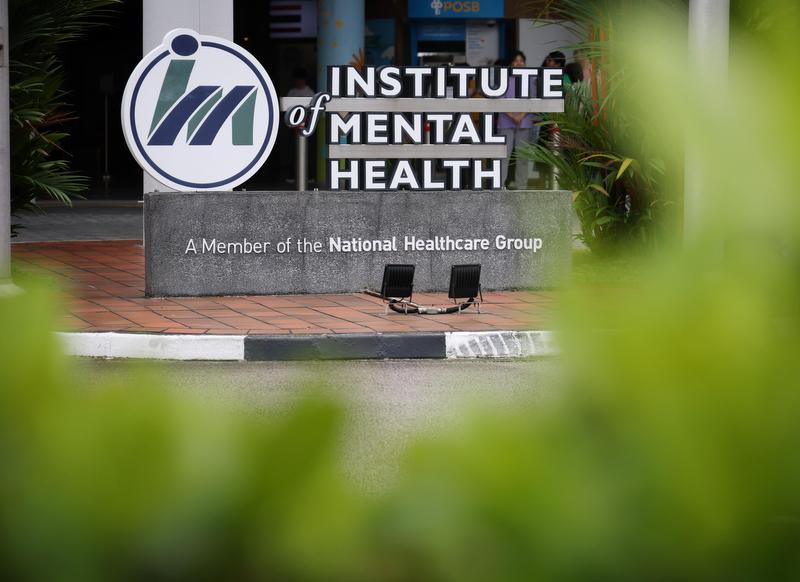
Following years of attempts to reshape the national conversation on mental health and tackle stigma, some feel that the Institute of Mental Health’s change of name, to the National Centre for Mental Health Singapore, and rebranding could move the needle on this score.ST PHOTO: JASON QUAH
Opposing Views
Can renaming IMH really tackle longstanding
mental health stigma?
The Institute of Mental Health is set to be renamed. Is this mere semantics,
or the start of a bigger shift?
The Institute of Mental Health (IMH) will be redeveloped, expanded and renamed the National Centre for Mental Health Singapore (NCMHS) in 2027. Following years of attempts to reshape the national conversation on mental health and tackle stigma, some feel that the change of name and the rebranding could move the needle on this score. The Straits Times’ Opinion editor Lin Suling and correspondent Grace Yeoh discuss.
Grace: If I had one word to describe my reaction to the news, it’d be scepticism. I’m not sure how impactful a name change will be – especially since IMH was already renamed from Woodbridge Hospital in 1993, and that didn’t really change public attitudes towards mental health. There is certainly more awareness now, but awareness hasn’t quite translated into acceptance.
What I really appreciated, however, were the plans to relook the need for parental consent, so young people who’re still in school can get help easier. Very often, parents are the source of mental distress at that age. Other than that, I don’t make much of the announcement.
Suling: I take a different view. The rising prevalence of poor mental health among Singaporeans post-Covid suggests more support will be welcomed. The sum difference goes beyond a simple name change.
In Singapore’s model, forming a national speciality centre should boost institutional capacity, catalyse funding and bolster dedicated research in theory. The formation of the National Cancer Centre Singapore (NCCS) in 1999 centralised medical, surgical and palliative specialists under one roof. An NCCS Cancer Fund was established. And today, there are specialised care programmes for geriatric oncology and for young adults.
We are now seeing a longer-term response to mental health challenges. This is a 14-year plan that lasts until at least 2040. But I’m getting ahead of myself. For now, don’t you think the change in name sends a strong signal, even if the immediate impact on attitudes may be marginal?
Grace: I do think the term “National Centre” legitimises mental health in a way that’s helpful for those who may have parents or employers who dismiss their struggles. At least this name change confirms to organisations that mental health is an important and ongoing concern, and that it wasn’t just a pandemic “fad”.
But I think the impact of this name change stops there. In the end, stigma is about how easy it is for you to tell your boss that you’re taking a day off to visit the psychiatrist, or how casually you update your friend that you’re seeking help for anxiety. If we can’t inject such candour into mundane conversations, there is still a societal mindset gap to bridge, which perhaps no overhaul of psychiatric care can fully address.
Suling: I think you’ve hit the nail on the head about needing to normalise talk about mental health. This goes back to your earlier point about parental consent potentially being a stumbling block for youth and whether there is a generational difference in attitudes.
The answer seems to point to yes. The willingness to seek help when one is unable to cope with stress is lower for older cohorts of Singaporeans surveyed in the National Population Health Survey, though I must say the overall number of 87.5% saying they would get help from professionals or informal networks makes me optimistic. And I’m also hoping our very Singaporean way of giving everything an acronym makes someone saying they’re going to the NCMHS a boring non-event. But am I just naive?
Grace: Perhaps it’s the word “institute” that carries the stigma. It makes me think that when I visit IMH, I’ll be locked away in a long-stay asylum. Whereas friends who seek help in other public and private hospitals, from Changi General Hospital to Gleneagles Hospital, readily talk about their doctors. These avenues don’t quite carry the same “shame” that people tend to associate with IMH. So you may have a point in hoping that eventually the name NCMHS will take on a similar normalcy, though it won’t happen that quickly.
I feel we’ve overlooked the fact that mental health is a cultural issue, not a health issue. Toxic work environments, unrealistic academic expectations and narrow definitions of success all affect one’s mental health significantly. So the solution, in my opinion, must also address all aspects of Singapore’s culture.
Suling: Changing culture takes decades, and we unfortunately do not have the luxury of time. The rising number of suicide deaths among youth – now the leading cause of death of those aged 10 to 29 – points to the need for acute care intervention and greater capacity to aid those with serious mental health conditions.
That said, I would also not discount the efforts under way to shape the national conversation around stress, competition and societal expectations, and tackle stigma regarding mental health. Like the “Life Beyond Grades” movement in 2018 that attempted to shift public attitudes around PSLE results. Or that there is a tripartite advisory that discourages employers from asking questions on mental health unrelated to the job. That we even have a National Mental Health Office in place says it all.
Grace: So, perhaps we can both agree that a realistic expectation to have for the new centre is greater accessibility to regulated professionals? I’m hoping this move to take psychiatric care more seriously will trickle down and result in fewer fly-by-night wellness and life coaches.
Better access should also mean shorter waiting times for an initial consultation or between sessions. As at 2025, the median wait time is 25 days for appointments at IMH across all referral channels. And as at 2024, the median wait time is 26 days for specialist child and adolescent mental health services across the National University Hospital and IMH combined. Both of which, as anyone in distress knows, are a very long time to wait.
Suling: You have raised a good point about triage. The new NCMHS system should hopefully see polyclinics and general practitioners enlisted in our Healthier SG care network tackle mild to moderate cases, while serious cases including those diagnosed with depression, schizophrenia or other severe conditions can be quickly surfaced for specialist care. The question is whether this can all come together this seamlessly.
My hope actually is also that the NCMHS focuses research on how to build personal resilience against multiple stressors because we would not want to over-medicalise mental health. With artificial intelligence upending education and the jobs market, dealing with this period of churn is not going to be easy.
Grace: That, I can definitely get behind. And it’s extra important that we have the right understanding of resilience. It’s really about the ability to adapt and recover through adversity – not toxic stoicism and pushing yourself past your breaking point.
If the NCMHS can move society’s understanding of mental health in this direction, then my sceptical mind may just be swayed.
Suling: And let’s hope we don’t get there only in 2040.