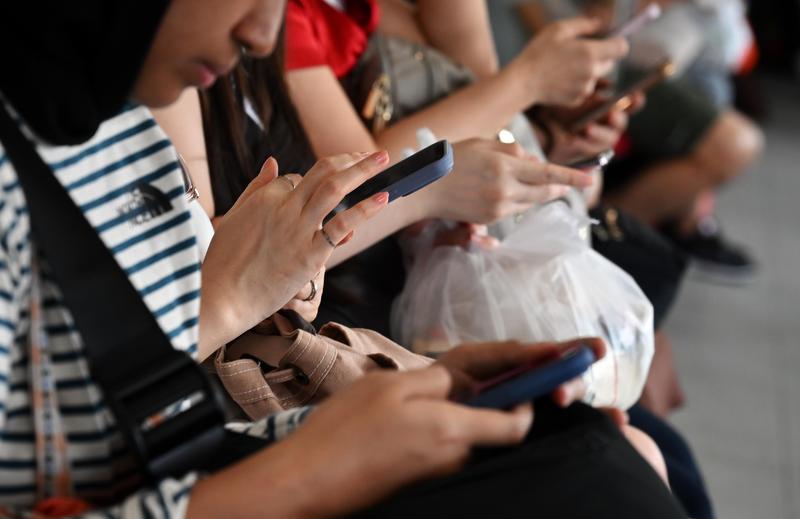
We have surrendered to the lure of never-ending text notifications, e-mails and the infinite scroll of social media, says the writer.ST PHOTO: KUA CHEE SIONG
Phones instead of books. And reading only social media. What we really lose
Each book or text we read exposes us to a different form of reading. And some ways of reading are better than others.
For many of us who grew up in an age before digital devices were ubiquitous, having a book within arm’s reach was likely second nature. No one would bat an eye if we pulled out a dog-eared paperback to peruse on the train or bus. In fact, you’d probably find yourself one among many.
Those days are behind us. We have abandoned the world of the printed word where one could end up getting so absorbed in a book that you risked missing your stop. Instead, we have surrendered to the lure of never-ending text notifications, e-mails and the infinite scroll of social media. Bookworm that I am, I, too, am not immune to the siren song of my phone screen.
We may think we’re reading a lot less. But the opposite is true – just that instead of reading a physical book, we’re reading what’s on our phone screens.
In fact, in launching the new national reading movement ReadSG, the National Library Board highlighted a global trend towards skimmable, short-form content.
In Singapore, the National Reading Habits Study 2024 found that while 89 per cent of adult respondents read more than once a week, only 28 per cent read books. Globally, a 2024 study found that as people spend more time on digital devices, the average time spent reading traditional books has decreased. Citing the American Time Use Survey, the study’s researchers noted that the average time spent reading print books fell from 21 minutes a day in 2005 to 16 minutes a day in 2018.
We know, instinctively, that we lose something amidst this shift. But what exactly are we losing?
Different forms of reading
It is well documented that reading fewer long-form texts can affect our critical thinking. We also risk becoming less able to identify nuances and subtleties in text. Singapore’s results in the recently released 2025 Programme for International Student Assessment (PISA) by the Organisation for Economic Co-operation and Development highlight this. While our 15-year-olds remain top in reading, our average reading scores fell by eight points from 543 in 2022 to 535 in 2025.
According to the latest report, there was a decline in the skills that matter most in the age of artificial intelligence: evaluating information, making connections across multiple sources, and thinking critically. Across countries, the share of “hasty readers” – students who rush through texts and give quick but incorrect answers – almost doubled between 2018 and 2025.
But we should also consider what we gain from reading different types of books.
Reading, as poet, graphic artist and literary critic Gwee Li Sui put it, helps you understand the world and see complexity. Through exposure to different types of language, readers also see the various ways in which this complexity can be explored.
Books also force us to sit with a text for a while, revisit pages that were read previously and rethink what we have previously thought. “You keep changing your mind as you read, and that shapes a different form of reading as opposed to short-form reading,” Gwee said in an episode of the podcast In Your Opinion.
Each book or text we read, he explained, exposes us to a different form of reading, through which we gain different things. Literature, for instance, may offer us creative and imaginative possibilities, but may not be as helpful in helping us understand society directly. But history books, or insights from political leaders, can help us understand controversies in society and the different angles from which people come into a social issue.
If we were to just stick to short-form texts, we would end up having only one form of reading. He is already seeing the effects of this on social media.
“Even though we read more, people are not understanding each other better,” he said. In fact, misunderstandings happen all the time. Some people, he said, are sarcastic or funny – but others don’t grasp the tone or subtleties of their meaning. That’s where disagreements, misunderstandings and questioning of motives start to happen. Some may try to use emojis to convey meaning, but this can only go so far. Gwee’s observation is a clear indicator of what we lose should we only have one form of reading. And the same goes for AI summaries. We may see AI summaries as a quick way to shortcut the reading process and gain information as quickly as possible. But it is a means to an end, which Gwee likens to spoilers in a movie.
“There is that extractive impulse in AI, when you use it to get to an end, whereas reading is an open process, and reading itself is to cultivate a certain thinking capacity – an inquisitive capacity in you,” he said.
Simply put, each type of reading teaches us something different. When we default to AI summaries and short-form, skimmable content, we end up short-changing ourselves.
An ‘extractive impulse’
In a bid to tackle this trend towards short-form, skimmable content, the Government has responded with ReadSG, which encourages people to read at least 15 minutes a day and log their sessions online, in order to collect virtual coins which can be exchanged for cash.
This will ostensibly instil discipline and get the habit to stick. Could people then end up enjoying the reading process and become lifelong readers without the need for an incentive?
Much ink has already been spilled debating whether the move will be effective or not. But what it reflects is a curious tendency we have as a society in tackling our problems.
Gwee describes it as an “extractive impulse” that works the same way as AI summaries. “When we go for something, we are always asking – what is it we want, and how are we going to get there as fast as we can?” he said.
But could this focus on results backfire? After all, how many of us were forced to read books we didn’t like in school, and end up deciding we don’t want to read them any more? This approach, says Gwee, is like saying: “I know that vegetables are good for us, and I’m going to make you all learn to love vegetables.” “I personally prefer people to discover for themselves that vegetables are good.”
Can we rush a love
for SingLit?
We see a similar “extractive impulse” in our push to make Singaporeans more cultured by giving them SG Culture Pass credits to spend on local arts, heritage experiences, and books.
It was recently reported that just 10% of the $300 million set aside for the scheme has been spent, prompting discussions on the reasons behind the low take-up rate.
However, it is possible that the credits could benefit local writers. Indeed, The Straits Times reported in April that SingLit sales spiked after the Culture Pass scheme was extended to books on March 1, with $539,000 worth of credits spent in bookstores in the first month.
Bookstores also highlighted an uptick in interest in SingLit titles, with one independent bookshop owner noting that the credits have enticed many who have never considered buying a SingLit text into his store.
Yet, what was striking was that children’s titles were the runaway drivers of sales, as, the article noted, “parents chose to cultivate their kids’ reading habits rather than feed their own”. Bookstores also reported parents making special outings to spend all combined $200 credits on stacks of books for their children.
Our ST bestseller lists also highlight this trend: While local titles are reasonably well represented for children’s books, SingLit remains a hard sell for local audiences in the adult fiction list compared with global titles.
Gwee noted that one reason many Singaporeans may not read SingLit is that from a young age, we have been exposed to and influenced by Western literature. “We become more attuned to their sensibilities and the way they think,” he said. This is why we see local students writing about autumn and winter despite not experiencing it here.
SingLit, meanwhile, deals with our local realities. “Perhaps we feel like reading international literature allows us to explore worlds that we might not be able to enjoy here,” said Gwee. “And we think that we are already familiar with Singaporean reality, why read about it?”
There’s something strangely ironic about parents who don’t pick up a local book for themselves, yet choose to invest in their children’s reading habits. But perhaps, if we focus more on cultivating a love of reading in the next generation rather than an immediate result, there’s hope for us yet. There’s a case to be made for exposing children early to as many different types of books and writing as possible. Parents may, for example, think Singlish is bad English and want their children to read only books that are in standard English.
But as Gwee said, when children are exposed to different types of English, they can tell the difference between the two and understand the complexities of the world. “If they are able to differentiate it from a young age, that is actually a very good skill.”
Besides, even if children don’t have the maturity to understand or appreciate certain types of writing and books now, there is always the likelihood that they will come back to it later when they’re older.
“I’ve gone through enough to know that some books were really hated or not well received at the time (they were released), but many years down the road, people say, ‘hey, that’s actually quite fun’,” said Gwee. “Or another generation would pick up a book and say, ‘I really did enjoy it.’”
A lasting appetite
To that end, the lesson to draw is ultimately this: Cultivating a love for reading and appetite for local books will take time. We should also accept that external campaigns, well intentioned as they are, might have limited effectiveness.
“The love of reading itself has to be cultivated, and it cannot just be cultivated from the outside,” said Gwee. Rather than looking at how we can nudge people into the habit of reading by incentivising them to log into an app to earn virtual coins, perhaps we should focus more on “planting seeds” by exposing the next generation to as many books as possible, and giving them the freedom to decide when and how they would like to read.
As a parent myself, I hope my pre-school children will grow up loving to read the printed word. That is exactly why I am surrounding them with as many books as possible, and letting them explore the different books in our libraries – whether they are simplified versions of classic works of literature, or informational books about how the world works.
My hope is that instead of counting down the minutes to earn their virtual coins in an app, the next generation will immerse themselves in a book and simply lose track of time.
Short-changing ourselves