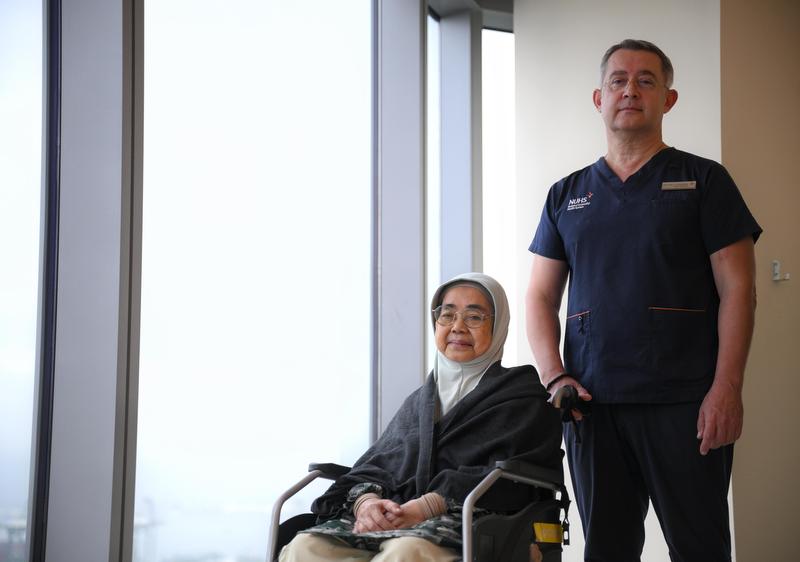
1 of 2 Homemaker Sariah Mansoor, who survived an aortic dissection, with senior consultant Vitaly A. Sorokin at the National University Heart Centre, Singapore.ST PHOTO: MARK CHEONG
What to know about deadly aortic dissections
About half of all patients who experience the cardiovascular emergency do not make it to hospital for life-saving treatment
Taiwanese singer Alien Huang died of it at the age of 36 in 2020, while American senator Lindsey Graham was 71 when he died of the same condition in July 2026.
Severe chest pain that feels like a stabbing or tearing pain is one of the most common symptoms of aortic dissection, which requires specific medical diagnostic tools to uncover. Described as a “moving pain”, it is often felt below the chest and may move to the back or below the shoulder blades. Patients may also feel it move to the shoulder or stomach.
They both experienced an aortic dissection, a catastrophic tear in the inner wall of the aorta, the main artery that carries blood from the heart to other parts of the body.
A heart attack, on the other hand, occurs when blood flow to the heart is blocked or greatly reduced.
Aortic dissection is one of the deadliest cardiovascular emergencies, where mortality increases with every passing hour without proper treatment. Globally, about 150,000 to 200,000 individuals die of the condition each year.
About half of the patients who experience an aortic dissection do not make it to hospital, says Vitaly A. Sorokin, an adjunct associate professor who is the head and a senior consultant of the Division of Adult Cardiac Surgery in the Department of Cardiac, Thoracic and Vascular Surgery at the National University Heart Centre, Singapore (NUHCS).
NUHCS has seen a doubling of aortic dissection operations, from about 15 cases annually a decade ago to about 35 cases now, he adds.
Surgery gives the best chance of survival, but some patients may be too ill for it when they are first seen at NUHCS. Palliative care is offered in such cases, Sorokin says.
NUHCS has also noticed an increase in younger patients, in their 40s, but did not reveal exact figures. Male patients outnumber female patients by a ratio of three to one.
Similarly, National Heart Centre Singapore (NHCS) has in recent years noticed an increasing number of aortic dissection cases.
There was an average of about 48 cases annually over the past decade, says Philip Pang, an assistant professor who is deputy head and a senior consultant of NHCS’ Department of Cardiothoracic Surgery. In comparison, there were 22 cases in 2015.
“This highlights the importance of recognising the condition early, even in younger patients, particularly when they present with symptoms suggestive of aortic dissection,” Pang says.
The trend is also apparent in some private practices. Lim Yeong Phang, a cardiothoracic surgeon from Mount Elizabeth Novena Hospital, reports more patients in their 40s and 50s who have undiagnosed high blood pressure and come in as emergency patients.
Even those from their teens to their 30s can experience aortic dissection if they have an underlying predisposition. This can include collagen disorders like Marfan syndrome, a genetic connective tissue disorder that affects the heart, eyes and skeleton, Lim adds.
Raising awareness
To raise more awareness of the little-known condition, NUHCS set up the Aortic (Heart) Screening Programme in December 2023, targeting higher-risk groups like men aged 65 and above who smoke or have coronary artery disease.
Eventually, Sorokin hopes to extend the screening to help younger patients detect dangerous aortic conditions.
Age is a major factor for aortic dissection, as the body becomes weaker and more fragile with advancing years. So is high blood pressure.
With people living longer, Sorokin expects the numbers to rise even further.
Severe chest pain that feels like a stabbing or tearing pain is one of the most common symptoms of aortic dissection, which requires specific medical diagnostic tools to uncover.
Described as a “moving pain”, it is often felt below the chest and may move to the back or below the shoulder blades. Patients may also feel it move to the shoulder or stomach.
The massive blood loss it causes can also lead to dizziness, clammy skin, nausea and vomiting, a rapid and weak pulse and shortness of breath when lying down.
Second chance
In Sariah Mansoor’s case, it felt like getting a hard knock on her upper back.
The 70-year-old homemaker experienced the pain on Dec 5, 2025, but did not want to see a doctor. One of her five children went over to her flat in Pasir Ris to massage her.
Her family called an ambulance at around 6am the next day when her blood pressure dropped and she complained of chest pain.
Sariah was rerouted from Changi General Hospital to NUHCS, which was better equipped to handle her case, and underwent emergency surgery after the centre diagnosed her with aortic dissection.
It was then that the doctors discovered she had undiagnosed atrial fibrillation, an irregular heartbeat that had for over a year caused occasional symptoms like palpitations and difficulty breathing.
Sariah also had a history of stroke and kidney issues, which may have been related to her high blood pressure and longstanding atrial fibrillation.
She had ignored the atrial fibrillation symptoms as they seemed unrelated and random.
After spending five days in the Cardiothoracic Intensive Care Unit following her surgery, she was transferred to a general ward. There, she developed complications related to the atrial fibrillation and was transferred back to intensive care. She received a pacemaker before being discharged in mid-January.
Sariah, who used to walk to and from the wet market and do all of her own household chores, is still undergoing rehabilitation. She uses a wheelchair as she cannot walk long distances, and her family has hired a helper.
She now avoids products containing caffeine or chilli, as both ingredients may trigger heart palpitations, given her existing hypertension and atrial fibrillation.
So, while she misses her morning coffee, Sariah lives each day with gratitude.
“God gave me a second chance,” she says. “If you are sick, see a doctor.”