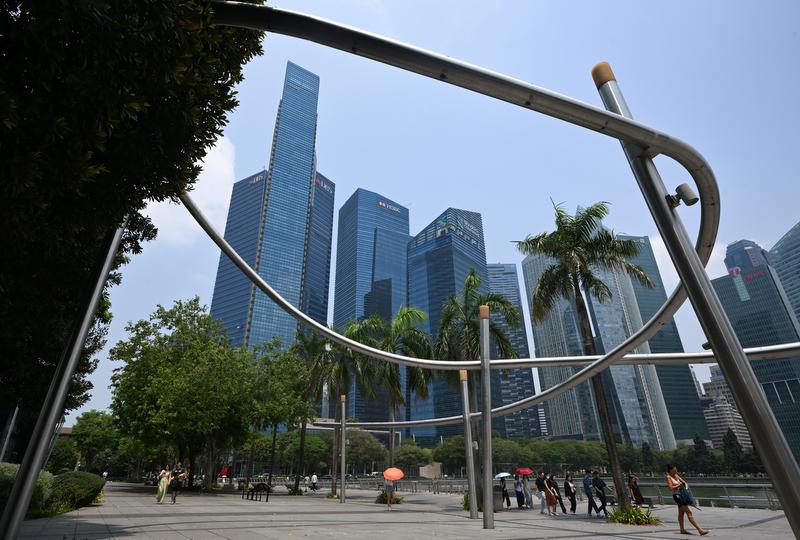
Singapore’s prosperity was built by persuading multinational corporations to locate serious activity here, then using their presence to upgrade workers, suppliers and institutions. The next phase should focus less on replacing MNCs with local champions and more on making Singapore harder to bypass, says the writer.ST PHOTO: LIM YAOHUI
Stop trying to build Singapore MNCs
The real path to economic resilience lies in deep-tech
niches, patient capital and
turning humble local suppliers into indispensable linchpins of
global supply chains.
To those who cite the dearth of world-beating Singapore companies, consider AEM Holdings and Micro-Mechanics.
Majority foreign-owned firms make up roughly a quarter of enterprises and a third of employment, yet generate about two-thirds of nominal value added. In 2025, foreign sources supplied about 95 per cent of the Economic Development Board’s fixed-asset investment commitments. Of the roughly $9 billion that businesses spent on R&D here in 2023, local enterprises – including government-linked companies – accounted for only about a fifth.
After a $17.9 million loss in 2009 put it on the Singapore Exchange’s watch list, AEM survived on one asset – Intel as a customer. Private equity investment in 2011 and four years spent rebuilding reliability and talent produced its High Density Modular Test platform, moving from laboratory units in 2015 to commercial production in 2016.
Revenue rose from $47.6 million to $221.6 million over that same span of time. The harder task – converting knowledge from one customer into technology that could travel beyond it – was met when Intel opened the ecosystem to its foundry customers, and later through AEM’s partnership with Advanced Semiconductor Engineering, the world’s largest company providing chip assembly, packaging and testing services based in Taiwan.
Micro-Mechanics survived a slower crucible. Started in 1983 with $1,200, one employee and a 500 sq ft workshop, it avoided competing head-on with equipment giants, focusing instead on consumable precision tools for critical semiconductor production processes. Four decades of refinement have taken it to more than 600 customers across five countries.
Neither merely supported multinational corporations. Both became hard to replace by solving narrow, costly problems, retaining engineering and research and development knowledge here. The lesson: An anchor customer supplies demand and credibility, but a supplier must use that to build its own business and diversify beyond its first customer.
A focused strategy
This short account should inform how Singapore anchors itself in global supply chains. At the 2026 National Day Rally, Prime Minister Lawrence Wong outlined a blueprint to master new technologies, attract leading companies, build local capabilities and equip Singaporeans with new skills. Singapore’s prosperity was built by persuading MNCs to locate serious activity here, then using their presence to upgrade workers, suppliers and institutions. The next phase should focus less on replacing MNCs with local champions and more on making Singapore harder to bypass.
The alternative is riskier: Building a domestic MNC from scratch can take decades of financing and failed bets, made harder by Singapore’s small market, which forces firms to internationalise before reaching scale at home. Using MNC demand as a proving ground does not eliminate that risk but reduces it – the goal is portable technology and market access, not remaining a sub-contractor indefinitely.
The numbers underscore why MNCs must stay anchored. Majority foreign-owned firms make up roughly a quarter of enterprises and a third of employment, yet generate about two-thirds of nominal value added. In 2025, foreign sources supplied about 95 per cent of the Economic Development Board’s fixed-asset investment commitments. Of the roughly $9 billion that businesses spent on R&D here in 2023, local enterprises – including government-linked companies – accounted for only about a fifth. This does not prove foreign firms are better run – they cluster in capital-intensive sectors – but it shows that local firms capture too small a share of the technology and pricing power around them.
The risk is not a dramatic MNC exit but a slow bleed – a regional team consolidated elsewhere, a research mandate trimmed, a supplier dropped from a procurement network. Each decision looks manageable alone, yet cumulatively they decide where technology and talent accumulate. Singapore should therefore score major incentive-supported MNC investments on two measures: the amount of capital, jobs and R&D committed, and the local capabilities created – suppliers qualified, engineers trained, local intellectual property (IP) created – to be reviewed after three to five years. This is not a local-content quota; Singapore firms would still meet global standards, but capable suppliers would get a credible route to qualification.
Lessons from Europe
To build more firms like AEM rather than hope they emerge, Switzerland and the Nordics offer an instructive comparison. Both built institutions around three problems that trap smaller firms: scarce skilled talent, capital unwilling to wait for industrial maturity, and the difficulty of turning research into sellable products.
Switzerland’s dual apprenticeship system gives technical vocations prestige and a steady worker pipeline, while multi-generational family ownership lets firms invest patiently rather than sell early. The VTT Technical Research Centre of Finland, a state-backed applied research and tech organisation, and the state-owned Research Institutes of Sweden tackled the problem of translation directly, giving smaller firms access to scientists, pilot facilities and testing infrastructure they could not afford alone – helping build supplier ecosystems around firms like Nokia and Ericsson.
Singapore lacks that vocational prestige and industrial lineage; its manufacturing base grew through foreign investment rather than organic development. But it is not starting from nothing. A*STAR already seconds scientists to local small and medium-sized enterprises (SMEs) and gives them access to advanced equipment. The question is whether this runs at sufficient scale in a few strategic niches, measured by products commercialised and IP retained.
A road map to build Singapore champions
Five moves would help. First, a long-horizon capital vehicle – Temasek, or EDB Investments-adjacent – with a mandate for 10- to 15-year holdings in deep-tech and precision-manufacturing SMEs. Existing schemes such as the Enterprise Financing Scheme, Startup SG Equity and the Anchor Fund address different gaps and come with certain constraints – loans must be repaid, venture debt runs shorter than a decade-long qualification cycle, and equity programmes favour high-growth start-ups or later-stage listings. What is missing is capital willing to stay through certification cycles and downturns, judged on supplier qualification and IP retained rather than exit speed.
Second, further enhance the Partnerships for Capability Transformation scheme so that IP ownership from joint development – including the supplier’s right to commercialise beyond the original customer – is settled before work begins, with MNCs receiving defined benefits such as first-use rights in return.
Third, restructure vocational pay and career ladders so precision-engineering apprenticeships become prestigious tracks with recognised progression to technician and engineering roles, and credentials that stack into engineering degrees.
Fourth, launch a succession-financing scheme so ageing SME owners can pass firms to the next generation, management or a trusted local buyer rather than sell abroad for lack of a succession route, supported by financing tied to keeping core IP and decision-making here.
Fifth, concentrate these efforts in niches where Singapore already has depth – back-end semiconductor testing, precision biologics tooling, speciality chemicals – rather than spread modest support across the whole economy.
None of this removes real constraints: Keeping suppliers replaceable is often rational for the MNC. Singapore’s small size caps cluster density, deeper technical access may also draw export-control scrutiny amid US-China tensions, and patient capital and engineering talent both remain scarce. Yet these challenges suggest a narrower, disciplined, milestone-linked programme is needed.
And if we get this right, in 10 years, success will be measured not just by the MNCs Singapore has attracted, but by the Singapore-based firms they rely on – firms with the IP, financing and market standing to survive losing any single customer.
Tan Chong Huat is chairman of RHTLaw Asia and the Asia Academy of Digital Economics. Tan Poh Hwee is president of the Asia Academy of Digital Economics.
Measuring success by S’pore-based firms that MNCs rely on