A closer look at the latest land use masterplan shows that many more new homes are in the pipeline.
80,000 new homes and counting
In the latest edition of Singapore’s land use blueprint, at least 80,000 public and private homes are slated for construction across more than 10 new housing areas, including Bukit Timah Turf City and Marina South.
Some of these areas were already set aside for housing in the 2019 version of the masterplan, while others, such as the Singapore Racecourse in Kranji, have been rezoned.
Changes like these between the 2019 and 2025 editions of the masterplan have been detailed in an interactive published online by The Straits Times on Dec 21.
Collectively, they show how land-scarce Singapore recycles land to meet the needs of an ever-growing and ever-changing population.
They also demonstrate the country’s attempts to balance redevelopment with the erasure of important social spaces, including through the conservation of built heritage.
In the Urban Redevelopment Authority’s (URA) Master Plan 2025, gazetted on Dec 1, Singapore has also allotted space for thousands of other new homes outside new housing areas – many close to amenities in existing towns.
A closer look at changes between the 2019 and 2025 masterplans reveal where some of these will be located.
For example, new homes are set to be built in the town centres of Yishun and Pasir Ris, near the MRT stations of the respective towns.
And by Mountbatten MRT station, several reserve sites – plots of land for which a long-term use has yet to be determined – were amalgamated into a site that is about 9ha in size and is now zoned for residential use.
Demand for new homes has been high in recent years, driven in part by population growth. The younger segment of the population, however, has been shrinking, and schools have consequently made way for new homes.
Singapore’s total population has grown from 4.03 million in the year 2000 to 6.11 million in 2025.
But the total enrolment in primary and secondary schools dropped from about 481,000 in 2000 to about 397,000 in 2023.
Correspondingly, the number primary and secondary schools in the country has fallen. There were 177 primary schools in 2024, down from 195 in 2000, and 132 secondary schools in 2024, down from 157 in 2000.
Checks by ST show that since November 2019, at least 10 education sites have been rezoned largely from education to housing use.
Based on the 2025 masterplan, the site occupied by Singapore Sports School in Woodlands is zoned a reserve site, indicating that its long-term use has yet to be determined.
The rezoning from education use follows an announcement in March that the Singapore Sports School will move to Kallang, and be located alongside the Singapore Sport Institute and the National Youth Sports Institute.
Similarly, in the 2025 plan, the site currently occupied by Anglo-Chinese School (Junior) in Winstedt Road has been rezoned from education use.
The site is now partially zoned for housing, with the remainder a reserve site, following news in 2023 that the school will eventually move to Barker Road.
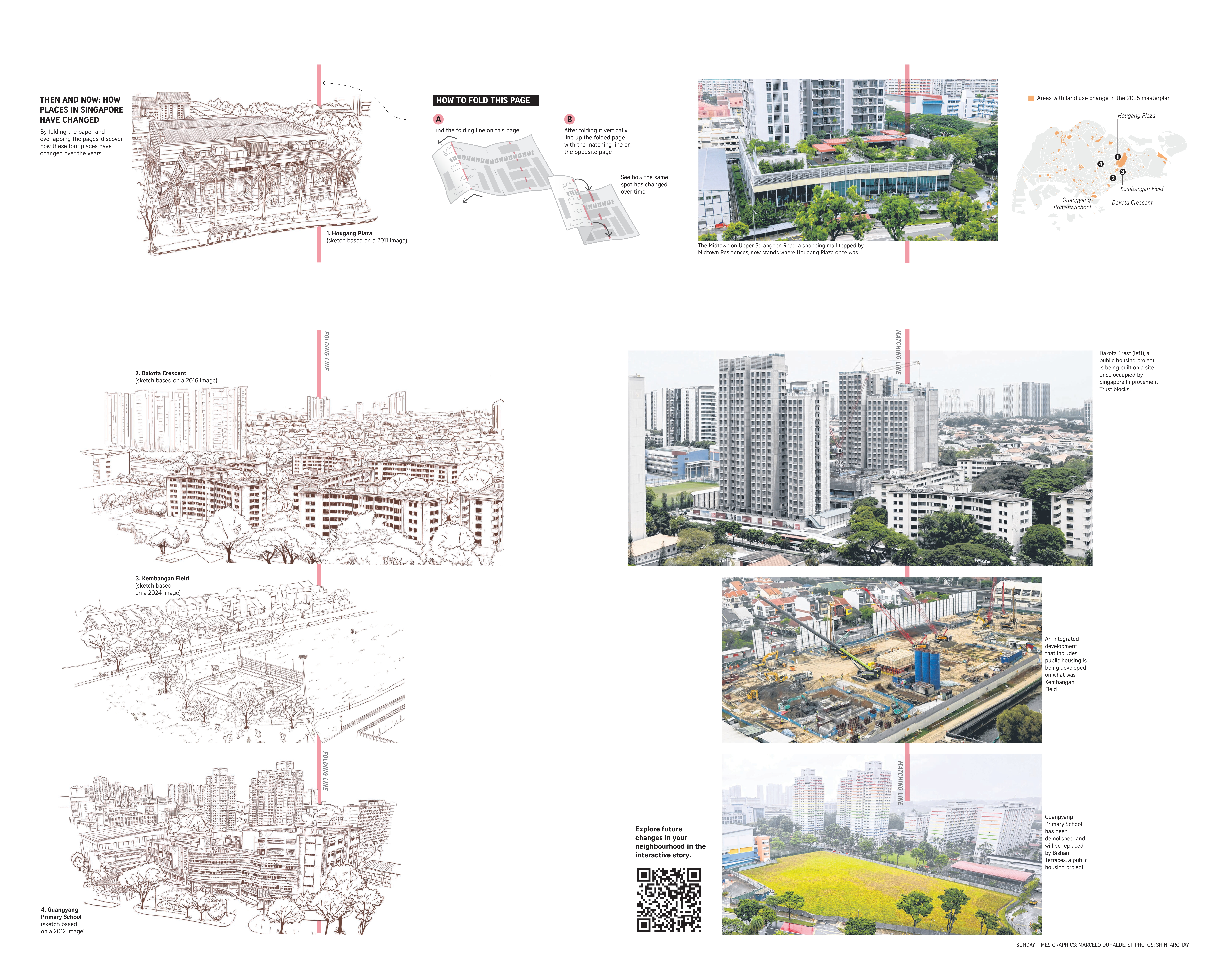
Also rezoned was the site formerly occupied by Guangyang Primary School in Bishan, after the school merged with Townsville Primary in 2023 and moved to the latter’s location in Ang Mo Kio.
Land that Guangyang occupied is now being redeveloped for a new public housing project called Bishan Terraces, which was launched in October 2025.
While recycling land no longer needed for school use helps to meet new needs, such redevelopment often comes with a social cost.
Dr Felicity Chan, a social researcher, notes: “There’s always tension between the need to redevelop and the desire to hold on to spaces where we’ve built memories and formed our identities.”
Dr Chan, a fellow at the Lee Kuan Yew Centre for Innovative Cities at the Singapore University of Technology and Design, adds that schools are where collective memories are forged, and where students spend their formative years and build a deep connection to the place.
Beyond schools, the loss of other everyday spaces such as malls and recreational spaces also tug at the heartstrings – evidenced by netizens sharing memories of Hougang Plaza, or an online petition against the redevelopment of a field in Kembangan.
“When familiar places from our growing-up years disappear, a part of those memories often fades with them,” says Dr Chan, who has been studying the relationship between change in neighbourhoods and residents’ sense of belonging since 2023.
She hopes her research can help urban planners rethink how Singapore’s built environment evolves.
The masterplan provides one solution: conservation – something the country has done since 1989 – while building new homes.
The former Pasir Panjang English School was among 33 buildings that were gazetted for conservation in the 2025 masterplan.
“Retaining the building with its storied history and integrating it with new uses as part of an upcoming residential development would give the building a new lease of life amidst efforts to introduce more housing options in central locations,” said the URA in June when it announced it would conserve the school.
Also conserved, and within a site zoned for housing, were six former housing blocks in Dakota Crescent.
Other blocks from the estate that were demolished are now being replaced by a public housing project, Dakota Crest, which is slated to be completed in 2027.
“We cannot stop changing in Singapore,” says Dr Chan. “But in that process of change, is there something we can hold on to?”
Some clues are offered in the URA’s recently exhibited plans for two other areas – Paya Lebar Air Base and Sembawang Shipyard.
In these areas, the URA has suggested that built heritage elements will be retained, although whether conservation is on the cards is not yet known.
Future plans for the Sembawang Shipyard “aim to creatively integrate unique structures of special significance to Singapore’s maritime past with new developments”, said the agency, while redeveloping the airbase will leverage heritage “such as the old airport structures and a section of the runway, to curate spaces for new social memories”.